WHEN THE SEA LIGHTS UP
A landscape is never still: it changes the moment light finds a surface capable of returning it.
By day, it may look like nothing more than water. Then night falls, something moves beneath the surface, and the sea answers with a blue flash. It is produced by microscopic organisms for which that light can be a matter of survival.
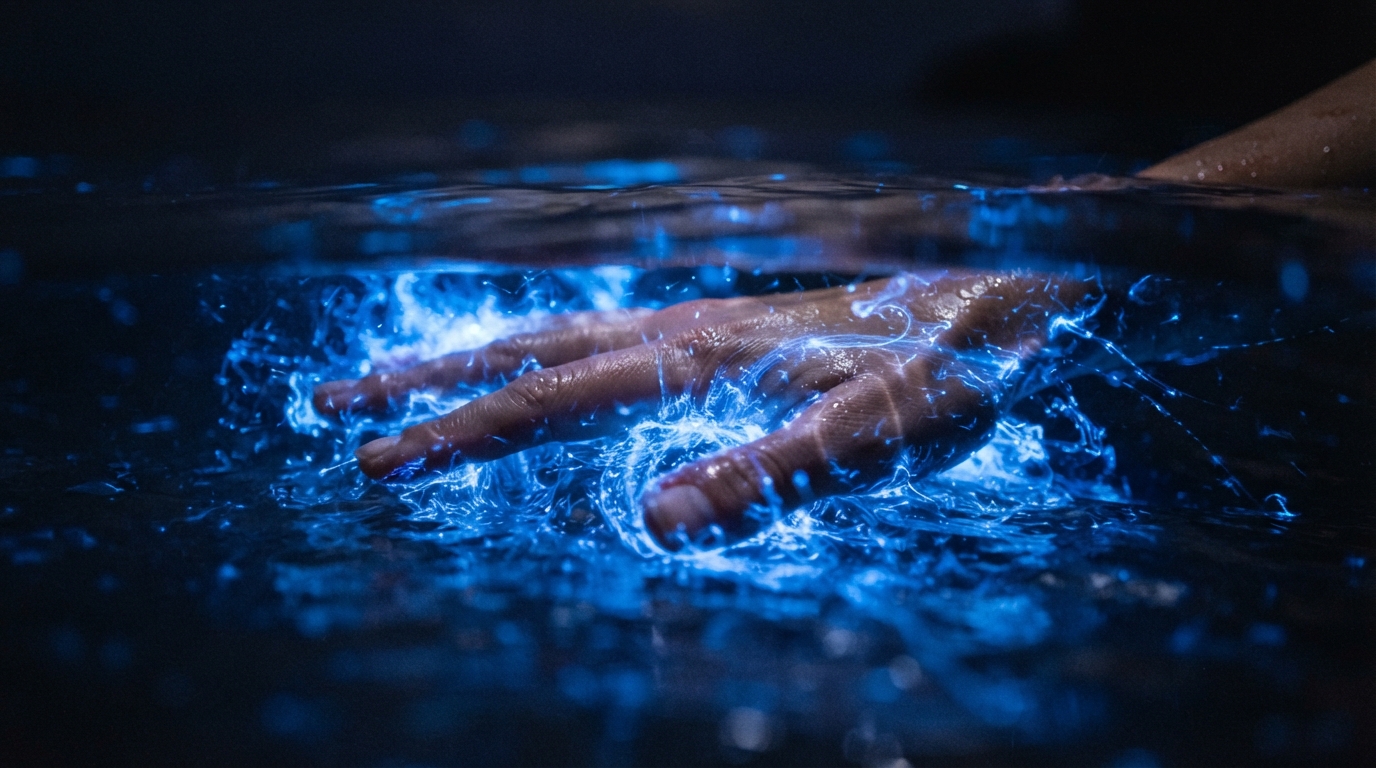
Imagine walking into the sea after dark. You take a few steps, move a hand through the water and, for an instant, something lights up: a blue trail follows your fingers, tiny points of light appear around your legs, a wave breaks on the shore and its edge becomes luminous. A few moments later, everything disappears until the next movement.
It is easy to watch such a scene and think that the sea is simply offering one of its most beautiful spectacles. From the perspective of the organisms producing that light, however, the story is very different. In some cases, what we see as a spectacular phenomenon is a response to something that has just touched them.
A night inhabited by millions of tiny lights
Among the organisms capable of making the sea luminous are dinoflagellates. One of the longest-studied is Lingulodinium polyedra, a single-celled organism found in marine waters which, when conditions favour high concentrations, can contribute to the spectacular expanses of bioluminescence seen along some coastlines.
Each individual cell is minute. Yet it contains a biological system capable of transforming a mechanical disturbance into a very brief flash of light. A wave can trigger it, as can the passage of a boat; when the water is disturbed, movement itself becomes visible.
To understand why this ability may have been preserved over the course of evolution, however, we must reduce the scale dramatically and imagine the encounter between a single cell and something trying to eat it. Experiments show that these organisms’ mechanical sensitivity can be compatible with the forces produced during an encounter with small planktonic predators. In Lingulodinium, the flash arrives within a few milliseconds—quickly enough to enter into the dynamics of the attack itself.
The luminous sea we watch from the shore thus takes on another meaning: what appears to our eyes as a landscape is composed, at the scale of plankton, of a multitude of organisms continuously responding to the environment in which they live.
Inside a cell, a flash
The light originates within tiny structures called scintillons, where the components of the bioluminescent reaction are concentrated. When the cell detects a mechanical stimulus, a sequence of electrical and chemical events begins; conditions within the scintillon change rapidly, and luciferin, through the action of luciferase, participates in the reaction that produces the flash. In Lingulodinium polyedra, the emission peaks in the blue range, at around 475 nanometres.
At cellular scale, the process has a remarkable precision, but its relationship with time is what makes it particularly interesting. The ability to produce light changes over the course of twenty-four hours: in Lingulodinium it is far greater during the night phase and almost absent during the day; exposure to light can also reduce the system’s sensitivity at night. The cell therefore regulates its bioluminescence according to a circadian rhythm.
This relationship between light and time introduces a curious reversal. Lingulodinium is photosynthetic and uses the light available in its environment during the day; when night falls, it can itself become a source of light. These are, of course, biologically distinct processes, but they belong to the life of the same organism and to its daily relationship with the alternation of day and night.
When a predator arrives
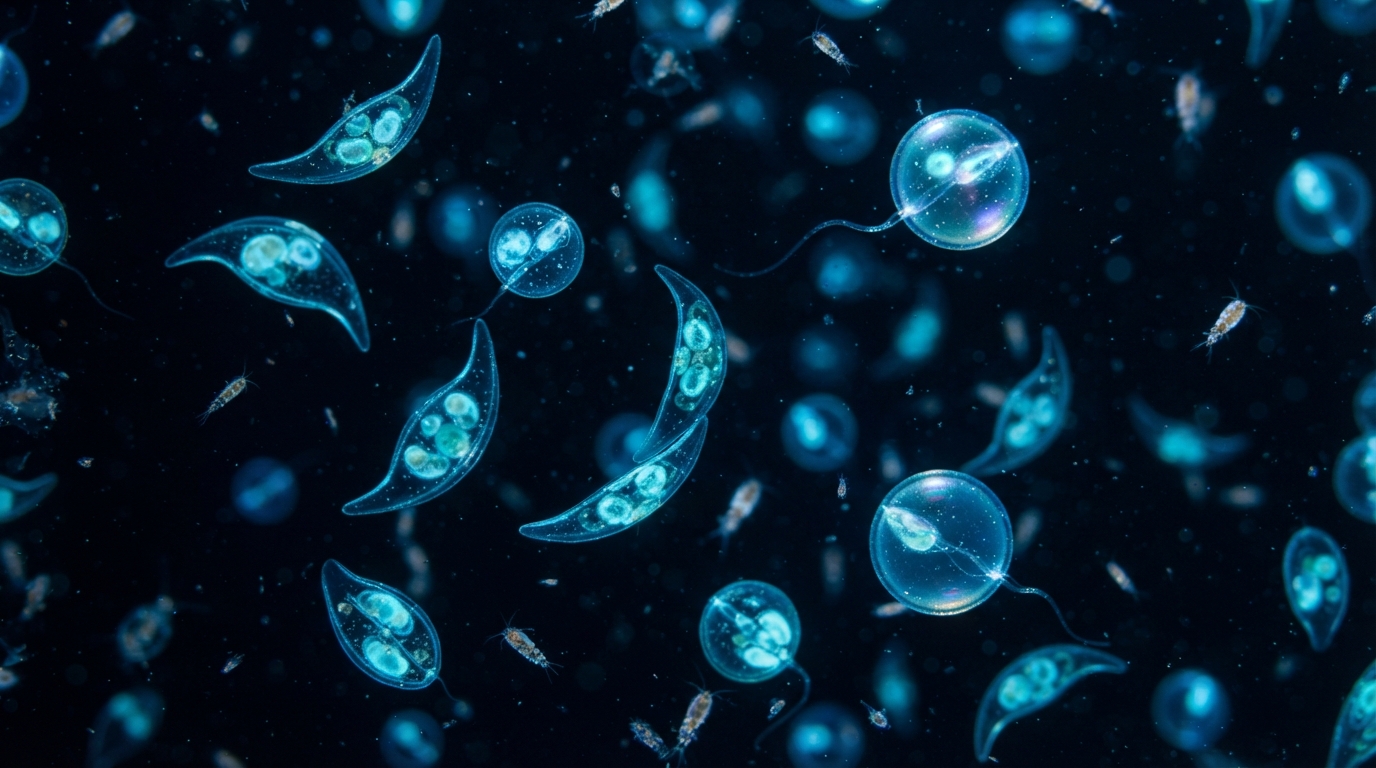
Copepods are tiny crustaceans and among the principal consumers of phytoplankton. For a dinoflagellate, encountering one can mean being ingested.
In 2017, a group of researchers observed something particularly revealing. When Lingulodinium polyedra was exposed to specific lipid compounds associated with copepods, known as copepodamides, its bioluminescent capacity increased. The presence of the predator’s chemical signals therefore altered the cell’s readiness to produce a light response.
Two years later, another experiment made it possible to observe more directly what happened during predation. When copepods came into contact with Lingulodinium cells primed for a stronger bioluminescent response, the cells flashed and the copepods’ feeding behaviour changed markedly. The dinoflagellate, initially a preferred prey, came close to being rejected; high-speed recordings showed cells emitting light on contact and then being expelled, apparently intact.
This is one of those instances in which a biological function, normally difficult to infer by simply observing the phenomenon, becomes almost visible. Contact with the predator produces the stimulus, the cell emits a flash, and the outcome of the encounter may change. What is light to us therefore takes on the character of a response within that ecological relationship.
Why switch on a light when a predator arrives?
One possibility is relatively intuitive: the flash may disturb whatever is attempting to eat the cell. Predation studies have indeed observed, under certain conditions, a reduction in consumption associated with bioluminescence.
There is also a more complex proposal, known as the burglar alarm hypothesis. If a small predator tries to eat a bioluminescent organism, the flash may make that predator visible to a larger one, attracting a second level of the food chain and indirectly increasing the chances of survival for the organism that produced the light.
Experiments conducted in different marine systems have supported this mechanism, while other studies indicate that its effectiveness may depend on the concentration of luminous organisms and on ecological conditions. It is therefore more accurate to understand dinoflagellate bioluminescence as part of a range of possible defensive functions, whose importance varies according to species, predators and environment, rather than to seek a single explanation valid in every situation.
This also shifts the way we observe the phenomenon. The beauty we attribute to bioluminescence belongs to our experience; the biological function of the light belongs to the life of the organism. They are two readings of the same event that can coexist without being confused.
Returning to the shore
We can now return to the opening scene with a little more information.
We enter the water, move a hand, and that blue trail appears as though materialising from the darkness. The gesture lasts barely a second for us, yet at microscopic scale it produces a mechanical disturbance to which thousands of cells may respond almost simultaneously. When concentrations are high enough, the sum of those very brief flashes becomes the phenomenon we see.
Understanding what is happening does not make the experience less astonishing. If anything, it changes the quality of the wonder, because behind an apparently simple image we begin to recognise a system made up of cells sensitive to their environment, circadian rhythms, chemical signals, predators and evolutionary strategies.
Bioluminescence then appears for what it is before it ever becomes a spectacle to our eyes: an ability developed by living organisms in order to act within their environment.
And when the sea lights up, for a few moments we can see that ability at work.
