SOGLIE — LA MATERIA DELLA LUCE
Light does not merely illuminate the surface: it emerges from matter and alters its depth.
What happens when a work truly enters a space? At Palazzo Pepoli Campogrande in Bologna, around twenty contemporary works encountered rooms that already possessed a powerful history, light and character. SOGLIE grew from this encounter, and from what begins to happen when people enter alongside the works.
Before the opening, there was a moment when the rooms were ready yet still empty.
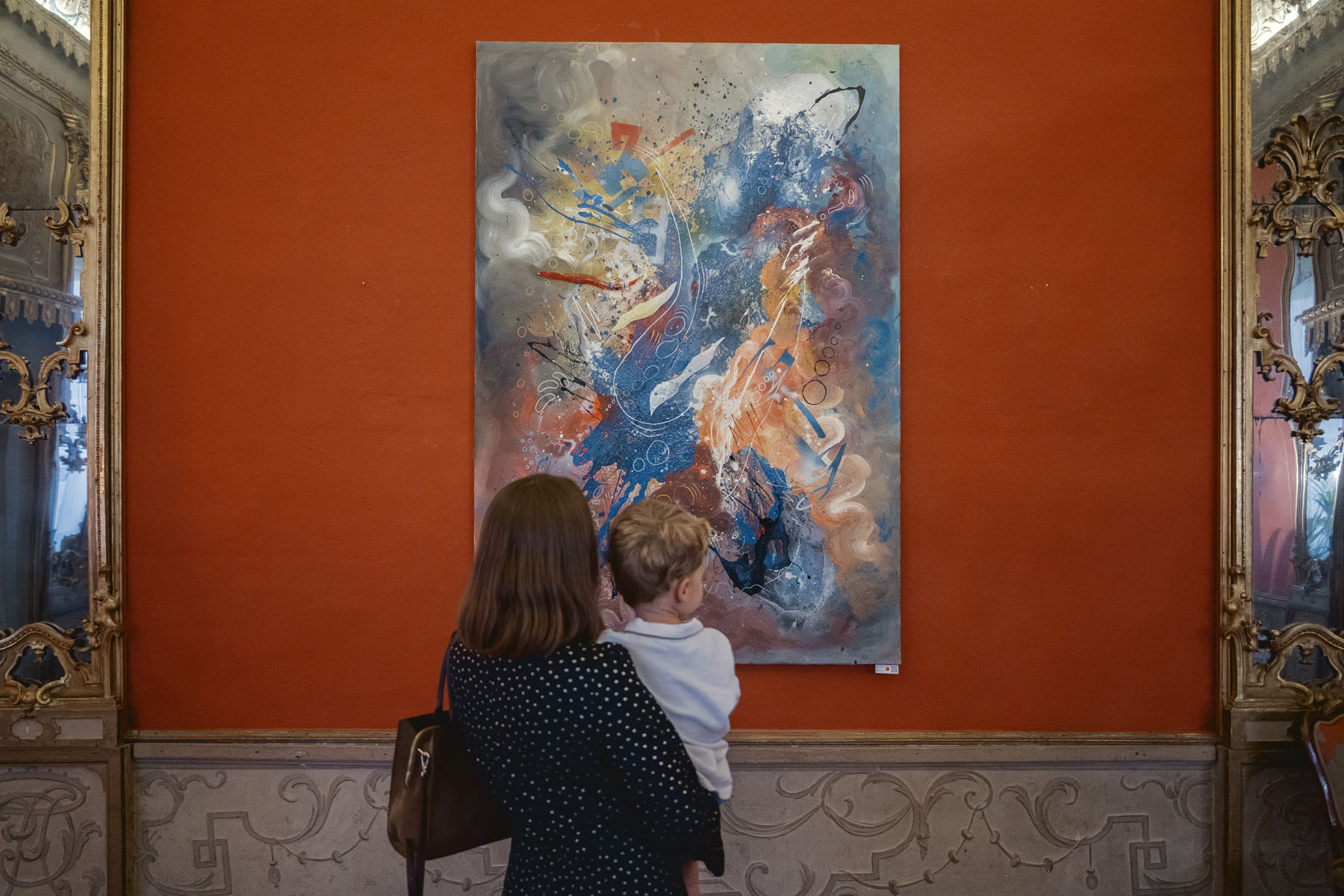
In the great red room, light entered sideways through the windows, crossed the curtains and drew long bands across the floor. Mirrors multiplied parts of the room, decorations ran along the walls to the ceiling, and two large paintings occupied very different positions within the space. One hung on the red wall, fully exposed to the room; the other stood at the centre of a decorative structure that seemed almost made to receive it.
It is difficult to look at a photograph of that room and determine precisely where the work ends and the place begins.
Not because the two become confused. Almost the opposite occurs: the palace retains its entire identity, and the paintings retain theirs. Yet once brought together, they begin to alter one another.
This is where it is worth entering SOGLIE — La materia della luce.
When a work finds a room
Palazzo Pepoli Campogrande is not a neutral space, and that is probably precisely what makes the encounter so compelling.
Some rooms bring red walls together with great mirrors, gilding and richly decorated ceilings; others have pale walls, tall windows and a quieter architectural presence. Moving from one room to another changes the amount of light, the colour surrounding the works and even the distance from which we can view them.
The exhibition brings together around twenty works made by Matteo Ferretti between 2002 and 2026, with large rectangular canvases alongside circular works and irregularly shaped surfaces.
The same painting, however, begins to behave differently according to the place it encounters.
In the red rooms, colour immediately enters into an intense relationship with its surroundings. Blues, greens, earth tones, whites and graphic marks coexist with the wealth of visual information already present in the architecture. The mirrors add another element: they return fragments of the works from unexpected viewpoints, make them reappear behind us and allow us to see them together with parts of the room that would remain outside our field of vision when looking directly at the painting.
Something different happens in the paler rooms. The works gain distance, more emptiness appears around the surface, and irregular forms become particularly evident. A canvas is no longer merely an image contained within a perimeter: its edge begins to take part in the wall, and the wall inevitably enters our perception of the work.
These are differences understood far better by walking than by describing them.
Light does not stand still
The exhibition title speaks of matter and light, but within the rooms light is first and foremost something very concrete.
It arrives through the windows, crosses fabrics and openings, encounters glossy and matt surfaces, is gathered by the mirrors and changes intensity over the course of the day. At times it remains diffuse; at others it enters decisively and crosses the floor.
As a result, what we see also changes.
One area of the painting may gain presence while another seems to recede. A mark that from a certain distance appeared almost absorbed by colour emerges when we move. The layers respond differently, and even the relationship between a work and the wall that holds it may seem more intense at one moment of the day and quieter a few hours later.
Here, La materia della luce ceases to be merely the title of an exhibition.
The painted matter remains physically the same, while our access to that matter continues to change. Light does not add meaning to the work: more simply, it allows us to encounter it each time under slightly different conditions.
We know this well outside art too. We enter the same room in the morning and in the evening, and it seems like another place. A wall takes on a different colour, a surface gains depth, and something that immediately drew the eye during the day may become almost invisible.
Inside an exhibition, however, we begin to pay attention to it.
Then the people arrive
When the doors open, the balance changes again.
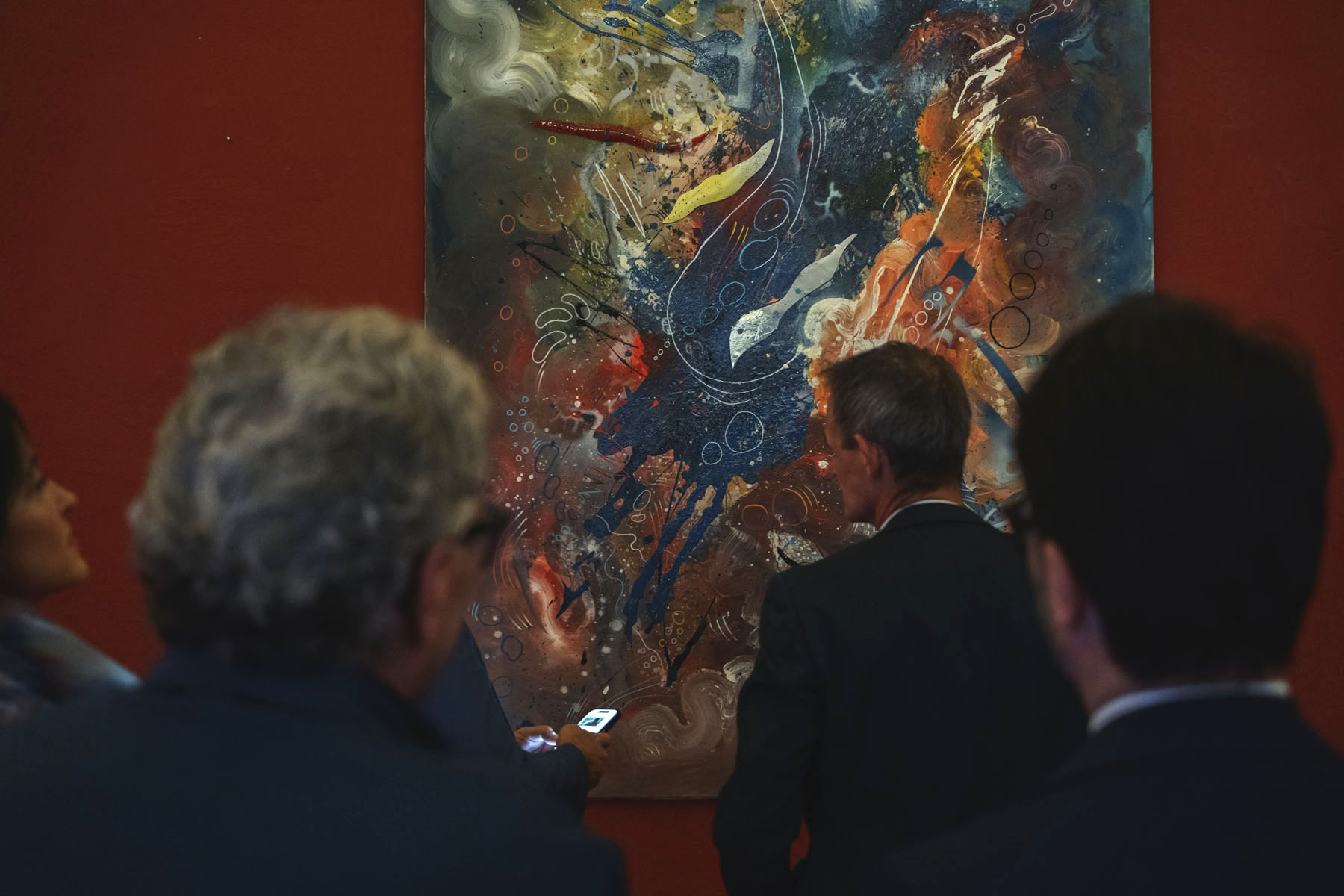
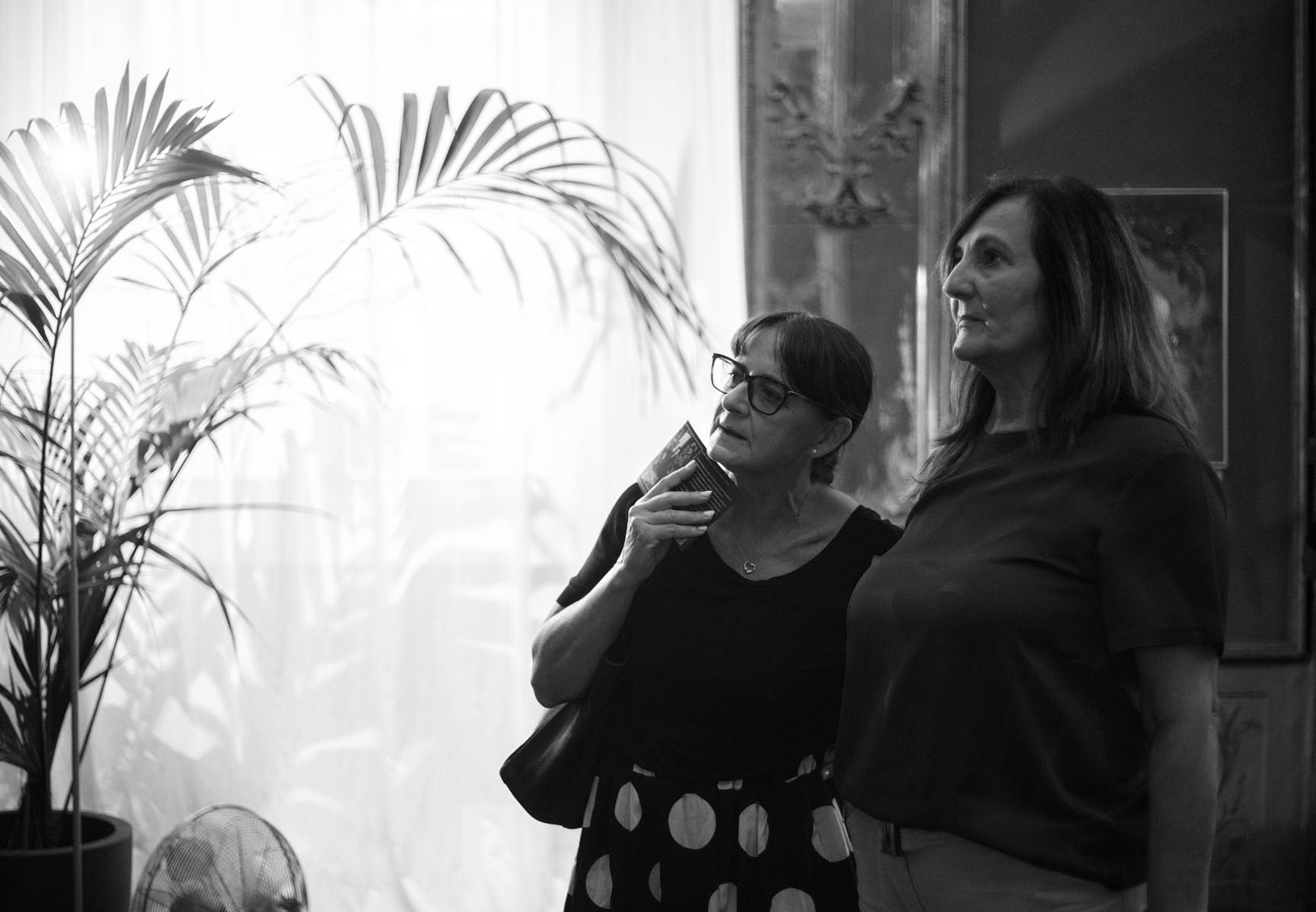
Photographs of the opening show very crowded rooms, but the interesting thing is not simply how many people entered. It is observing how they began to occupy the space.
In front of the larger works, visitors naturally tend to step back. In some rooms, people arrange themselves almost in a semicircle, leaving enough distance between themselves and the painting to hold it entirely within their gaze. Some remain at the edges, some move closer, while others seek another position. Some take photographs; others, while listening, continue looking at a work behind whoever is speaking.
We cannot know what each person felt, and it would be arbitrary to assign a feeling to them. We can, however, see bodies moving and observe how the presence of the works helps to organise the space around them, temporarily.
This is perhaps one of the simplest things an exhibition makes visible.
When a room is empty, architecture establishes much of its hierarchy. A doorway invites passage, a window draws the eye, a fireplace or decoration defines a centre. To introduce a work is to introduce another presence into that balance. When people then arrive, those hierarchies are continually renegotiated through movement.
We approach what we want to see more clearly. We step back when we need to understand its scale. We move if someone passes in front of us. We cross a doorway because we glimpse something in the next room.
The exhibition thus begins to exist through the paths taken by those who visit it.



Looking through
The mirrors of Palazzo Pepoli Campogrande make this movement particularly evident.
They are part of the architecture, but during SOGLIE they also become involuntary devices for seeing. While looking at one canvas, we may glimpse another reflected a few metres behind us. Alongside the work, we see a window, a fragment of ceiling or someone crossing the room.
Our gaze does not remain confined to the surface of the canvas.
This creates a curious situation: some works may be encountered indirectly before being seen head-on. We see them appear in a mirror, perhaps only in part, and a few steps later find them before us.
The palace therefore constructs anticipations that no installation could completely design in advance, because they depend on the precise point at which we stand and the direction in which we are looking.
At that point, the threshold is also very physical. It is the door separating two rooms, the reflection showing us something we have not yet reached, the passage from a red wall to a pale one, from a crowded room to one momentarily empty.
Each time, our way of seeing what comes next changes.
A work never arrives alone
SOGLIE was conceived as a path in which the works would alter the perception of space and the visitor would progressively enter the body of the exhibition. Once the doors opened, that premise encountered something far more concrete: a real building, changing light and people freely choosing where to pause.
This is probably where an exhibition ceases to belong entirely to those who imagined it.
The artist may choose the works. Their positions can be decided, distances studied and a path constructed. The palace brings centuries of history and its own architecture. Then someone who took part in none of those decisions enters and looks.
From that moment, the experience belongs to them too.
They may stop before the work we imagined as central, or pass swiftly through that room and remain much longer before a work at the side. They may notice a reflection no one foresaw, approach a surface to examine a detail, or simply choose to spend a few minutes in one room.
It is an important freedom, because it completes what the installation can only begin.
What crosses the threshold
Looking at the empty rooms and then at those same rooms during the opening, the difference is evident. The works have remained in the same place, the palace is the same, and yet the space has taken on another life.
Perhaps the most interesting threshold in this exhibition lies precisely there: in the moment when something conceived, painted and placed in space finally encounters a person who arrives without knowing exactly what they will find.
The work carries its own matter. The palace offers it a wall, a scale, a history and a light that will continue to change. Whoever enters adds their gaze, the time they choose to give it and the personal way in which they will move through the rooms.
From that moment, none of the three elements can tell alone what is happening.
It is in the space that separates them and at the same time brings them into relation that SOGLIE finds its meaning.
Because a threshold truly exists only when someone crosses it.